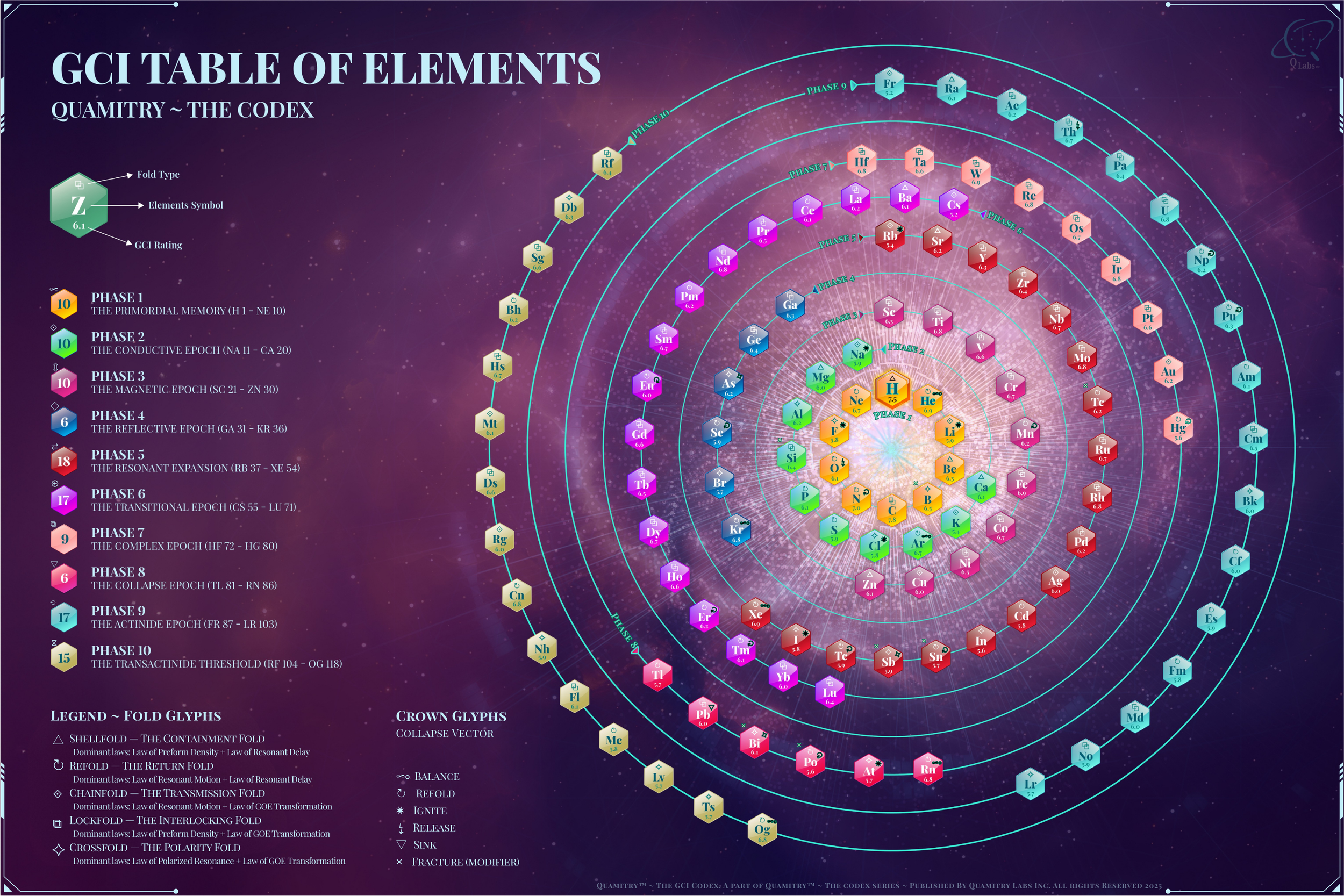
THE GCI TABLE
A Structural Reinterpretation of the Elements
The Geometric Compression Index (GCI) Table is a visual and structural reinterpretation of the chemical elements through the lens of geometry, resonance, and stability.
It does not replace the standard periodic table.
It asks a different question.
Rather than organizing elements primarily by atomic number and electron configuration, the GCI Table examines how elements store, transmit, and release resonance based on geometric constraint and compression behavior.
What the GCI Table Represents
The GCI Table treats elements as structural systems, not just atomic identities.
Each element is interpreted according to how its internal geometry constrains motion, how resonance is retained or released, and how stability emerges or fails under compression. In this view, periodicity is not only numerical ~ it is geometric and behavioral.
The table functions as a map of structural tendencies, not a catalog of particles.
What the GCI Table Is Not
The GCI Table is not:
A replacement for the conventional periodic table
A proposal to redefine atomic physics
A claim that existing chemistry is incorrect
The standard periodic table remains indispensable for chemical identity, reactions, and measurement. The GCI Table exists alongside it, offering a complementary structural perspective that conventional organization does not attempt to provide.
Why the GCI Table Exists
Traditional element organization excels at classification.
It is less effective at explaining behavior under constraint.
The GCI Table was developed to explore questions such as:
Why certain elements fracture while others deform
Why stability thresholds vary dramatically across materials
Why resonance retention differs even among chemically similar elements
How structural behavior scales from atomic to macroscopic systems
By reframing elements as geometric compression systems, the GCI Table provides a conceptual bridge between material behavior, resonance theory, and applied measurement.
Relationship to the Quamitry Framework
The GCI Table is one of the most visible artifacts of the Quamitry framework.
It draws directly from Quamitry’s core principles:
Geometry as instruction
Resonance over force
Structure before substance
Stability as constrained persistence
Within Quamitry, the GCI Table acts as a visual index ~ a way to see how abstract principles manifest across the elemental landscape.
Reference Materials and Visual Atlases
The GCI Table is presented in both analytical and visual forms, including large-format reference atlases designed for study and comparison.
These materials are intended to function as working references, not decorative charts ~ objects that invite slow examination and repeated use.
Details, interpretations, and supporting models are documented within the Quamitry Codices and expanded through the Archive.
The GCI Table does not ask to be accepted.
It asks to be examined.