
What is Quamitry?
Quamitry is a framework for understanding reality through geometry, resonance, and structure, rather than particles and forces alone.
At its core, Quamitry proposes that matter, energy, and time are not fundamental objects, but behaviors of a deeper geometric lattice ~ patterns of compression, release, and resonance that repeat across scale. What we experience as mass, charge, decay, and motion emerge from how this lattice stores and transmits oscillation.
Instead of asking what things are made of, Quamitry asks a different question:
What structures persist, and why?
A geometry-first view of the universe
In traditional physics, complexity is built upward ~ particles form atoms, atoms form matter, matter forms systems. Quamitry approaches the problem from the opposite direction.
It treats geometry as instruction.
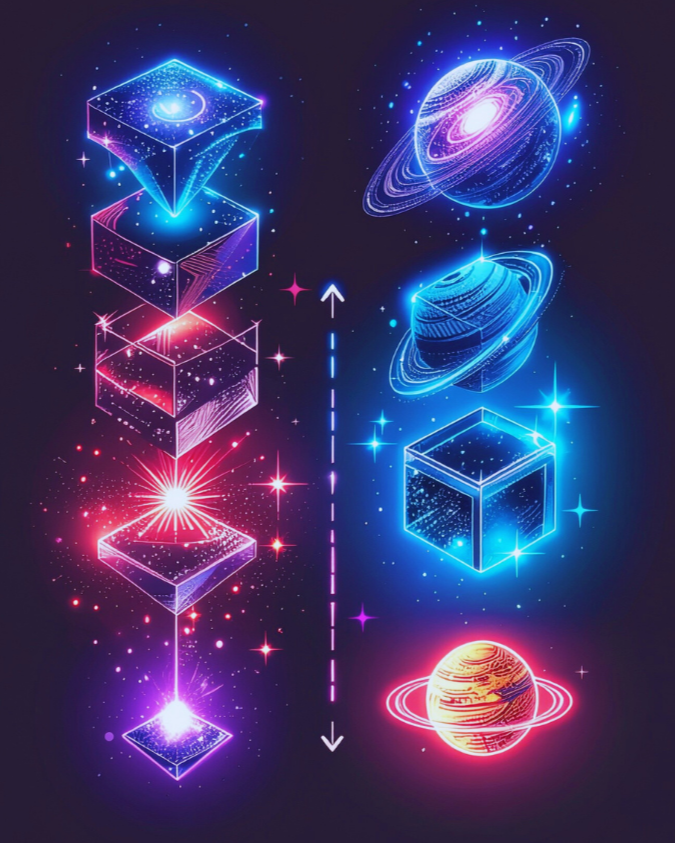
Compressed geometric patterns act as stable memory. Resonance flows through those patterns. Where geometry holds, structure persists. Where it fails, energy releases, transforms, or collapses. Time itself appears not as a background parameter, but as a delay created by fold transitions within the lattice.
From this perspective, chemistry, physics, cosmology, and even biological rhythms are not separate domains ~ they are expressions of the same underlying logic at different scales.
What makes Quamitry different
Quamitry is not an attempt to replace existing physics, nor is it a rejection of experimental science. It is a reframing ~ a way of organizing known behavior around structure and resonance rather than abstraction alone.
The framework introduces:
The Geometric Compression Index (GCI), which maps elemental stability and behavior
A fold typology that replaces static orbital models with dynamic geometric roles
A view of entropy as structural release, not disorder
Time as a resonant constraint, not a universal clock
A path toward experimental testing through resonance-based instrumentation
These ideas are explored across several works, including OmniFinite Horizon, The Field Codex, and The GCI Codex.
A living body of work
Quamitry is not presented as a finished doctrine. It is a growing artifact.
Historically, scientific communities formed around shared texts ~ notebooks, marginalia, correspondence, and revisions. Quamitry returns to that model, updated for a modern world. The Codices act as shared memory, refined over time as ideas are tested, clarified, and extended.
The goal is not speed, virality, or consensus by volume, but coherence by accumulation.
Who is building this
Quamitry is being developed by Keith Mountjoy, an independent researcher and systems thinker exploring how geometry, resonance, and compression can unify patterns across physics, chemistry, and time.
Rather than beginning with institutions or funding, this work began with observation, synthesis, and long-form construction — building the framework first, then opening it to scrutiny, dialogue, and eventual experimentation.
This work is accompanied by published volumes, a formal preprint outlining the Anchor Principle, and the development of a resonance-based measurement instrument intended for experimental validation.
The emphasis is simple:
Build something that holds.
Test it.
Let the structure speak.
Where this leads
Quamitry is intended to be:
A reference for researchers and educators
A conceptual tool for interdisciplinary thinking
A foundation for experimental work, including resonance-based instrumentation
A shared map for a learning community that values clarity over noise
If you are curious, skeptical, or simply willing to think in a different direction, you’re in the right place.
Quamitry is an invitation to look at what persists ~ and ask why.
Looking for a deeper technical overview?
This page is intended as a conceptual orientation.
For readers seeking a structured and more technical outline of the Quamitry framework ~ including its foundational principles, classification system, and experimental direction. A formal overview is available below.